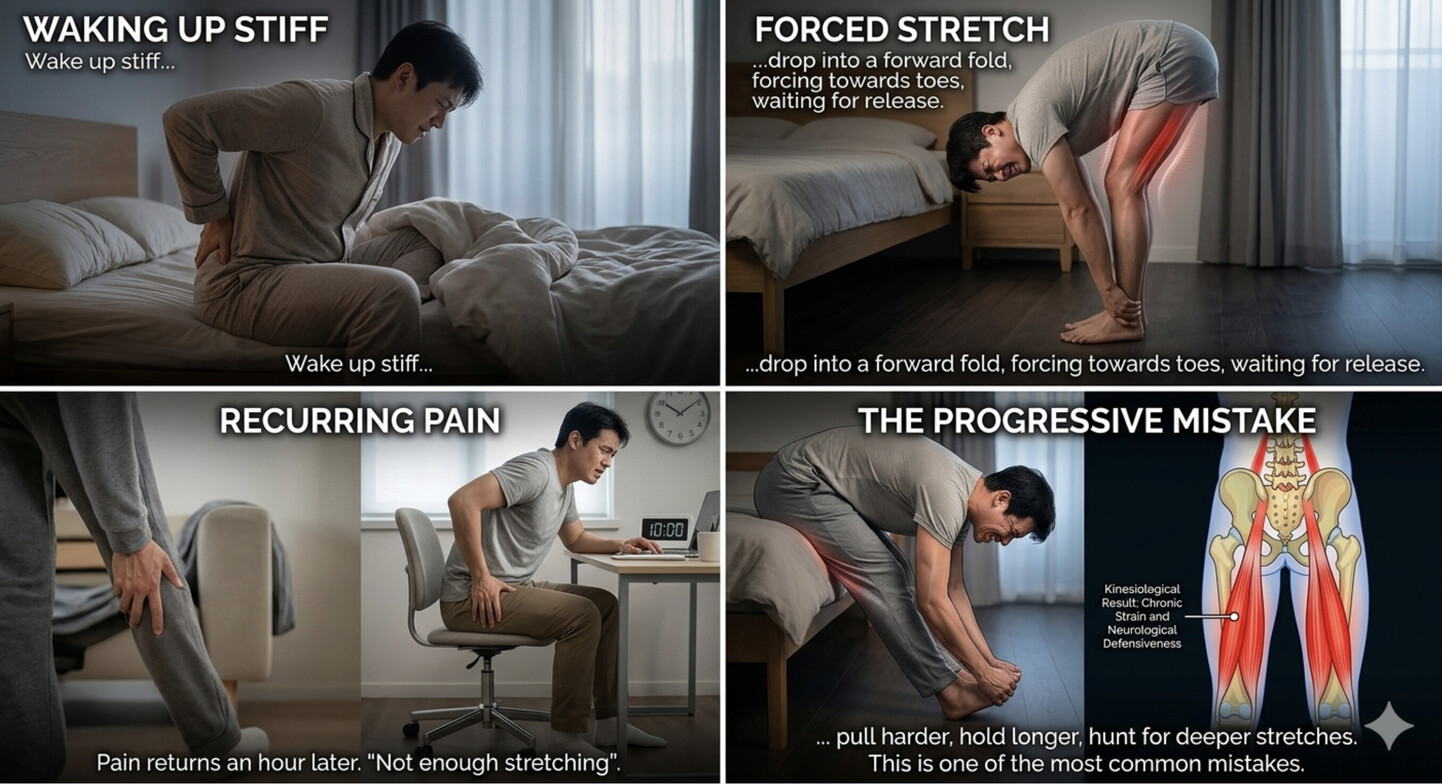

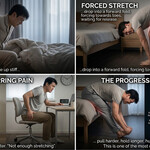

You wake up stiff, drop into a forward fold, and try to force your hands toward your toes, waiting for that tight sensation in the back of your legs to release.
When the pain returns an hour later, you assume you just haven't stretched enough, so you pull harder, hold longer, and hunt for deeper stretches.
But from a neuro-somatic and kinesiological standpoint, this is one of the most common mistakes in structural health.
In many cases, stretching your hamstrings and lower back isn’t curing your pain, it is actively aggravating the injury. By blindly pulling on tissue without understanding your body's neural pathways and structural counterbalances, you are forcing your nervous system to stay locked in a chronic pain cycle.
Let’s look at the real biomechanics of lower back pain, how it links to Eastern organ meridians, and why your body needs stabilization over stretching.
1. The Kinesiological Reality: The Illusion of Tightness
To understand why stretching fails, we have to look at the law of reciprocal inhibition and pelvic alignment. Your pelvis is the foundation of your entire spine. When your pelvis shifts out of its neutral alignment, it drags the surrounding muscle groups with it.
The most common structural imbalance in modern society is an Anterior Pelvic Tilt; where the pelvis tips forward like a bucket spilling water out the front.
- The Hip Flexor Pull: Sitting at a desk for hours causes your hip flexors (the psoas and rectus femoris) to become short, locked, and aggressively tight. This physical shortness pulls the front of your pelvis downward.
- The Hamstring Stretch: As the back of your pelvis tilts upward, it physically pulls your hamstrings into a state of maximal elongation. Your hamstrings are being stretched taut like a rubber band before you ever even attempt to bend over.
When a muscle is chronically over-elongated, the brain steps in to protect it from tearing. It floods the muscle with neurological tone, making it feel stiff, rigid, and "tight." This is locked-long tightness, not structural shortness.
"Bending over to aggressively stretch an already over-elongated hamstring tears at the tendon attachments, destabilizes your pelvic base, and forces your lower back muscles to seize up even harder to hold your skeleton together."
     [Short, Locked Hip Flexors] ──► Pulls Front of Pelvis Down
                   │
                   ▼
     [Anterior Pelvic Tilt Induced]  ──► Forces Rear of Pelvis Up
                   │
                   ▼
     [Hamstrings Pulled Taut (Locked-Long)] ──► Brain Sends "Stiffness" Signal
                   │
                   ▼
     [Aggressive Hamstring Stretching] ──► Destabilizes Lower Back & Spine
2. The Neural Pathway: The Stretch Reflex and Nerve Gliding
Your nervous system has a built-in emergency braking mechanism known as the myotatic stretch reflex.
"When you pull a muscle too far or too fast, specialized sensory receptors called muscle spindles send an instantaneous signal to your spinal cord."
The spinal cord responds by forcing the muscle to violently contract to prevent joint dislocation.
When you aggressively hold a deep hamstring stretch through intense discomfort, you are actively fighting your own neural software. You trigger a fight-or-flight response inside the muscle tissue itself.
Furthermore, what many people mistake for a deep hamstring stretch is actually tension on the Sciatic Nerve.
- Your sciatic nerve roots exit the lower spine and travel all the way down the back of your legs to your feet.
- Nerves do not like to be stretched; they need to glide smoothly through muscular tunnels.
- Yanking on your legs while rounding your lower back compresses the nerve roots at the spine while over-tensioning the nerve pathway, resulting in localized inflammation, burning sensations, and protective muscle spasms in the lower back.
3. The Eastern Meridian Perspective: The Bladder and Kidney Grid
Traditional Eastern Medicine maps this structural back trap beautifully through the Bladder Meridian, the longest meridian channel in the body.
The Bladder meridian begins at the eyes, travels over the top of the head, runs in two parallel lines completely down the length of the spine, passes through the glutes, and travels straight down the back of the hamstrings to the pinky toe.
- The Stagnation Loop: The Bladder meridian is the primary energetic shield of the body, and it works in close partnership with the Kidney system, which governs structural bone health and spinal integrity.
- The Emotional Link: When your body is storing fear, chronic stress, or structural exhaustion, the energy in the Bladder meridian stagnates and hardens. This energetic freeze causes the entire posterior chain of your body, from your lower back to your calves, to become rigid and unyielding.
"Trying to mechanically force a stagnated Bladder meridian to open through aggressive stretching is like pulling a knot tighter."
It shocks the Kidney energy, depletes your physical vitality, and deepens the baseline energetic blockages. True release requires clearing the stagnation at the root rather than attacking the tissue at its weakest point.
4. Rebalancing the Architecture: Stabilization over Stretching
To truly heal chronic lower back pain, you have to stop stretching what is already long and start releasing what is actually short.
True neuro-somatic rehabilitation focuses on re-establishing pelvic neutrality and neurological safety.
- Release the Front: Instead of pulling on your hamstrings, you must manually deactivate and decompress the short, locked-short hip flexors and deep quads at the front of the body.
- Activate the Core: Once the front releases, you must gently wake up the deep abdominal stabilizers and glutes to pull the pelvis back into a level, supportive alignment.
- Calm the Pathway: By using gentle, somatic movement and meridian tracking, you clear the energetic stagnation in the Bladder channel without shocking the nervous system's stretch reflex. This allows the hamstrings to naturally soften without a single second of painful stretching.
Restore Your Structural Foundation with QiKiSol
"Your lower back pain is not a life sentence of stiffness, and your hamstrings are not the enemy. Your body is simply screaming for alignment, stability, and intelligent listening."
At QiKiSol, our Neuro-Somatic Acupressure and Human Performance Consulting approach looks entirely past the localized symptom. We evaluate your entire global structure, analyze your pelvic blueprint, and map out exactly where your nervous system and meridians are holding tension.
By safely releasing hidden structural restrictions and teaching your body how to stabilize itself, we lift the pressure off your spine and return you to fluid, pain-free movement.
Stop yanking on your tissue. Start aligning your structure.
Explore our hybrid mentorship pathways or book your personalized structural assessment at our sanctuary to experience genuine rehabilitation today.
Doc QiKi
Contact Me